Posts Tagged ‘physics’
Neutrinos – tough to think about

the standard model – pre-Higgs
I recently told myself that I would focus more on my ‘main topic’, bonobos and human culture, patriarchy and matriarchy and all that stuff, and yet…
I can’t keep to the script. Now I’m thinking about physics, and whether neutrinos have mass. But how can a particle not have mass? Light is described in terms of waves and their lengths, but also in terms of photons, particles that have no mass. But surely that makes no sense, or at least common sense. In order to comprehend this you have to start thinking about the equation of mass with energy, and perhaps stop thinking of a photon as a particle, but instead as an energy package. Quantised energy? Einstein’s famous theory related mass to energy, and light-speed. We can only get to light-speed by converting our mass to ‘pure’ energy. And it’s best to think of these things abstractly, rather than worrying about weight-loss. When we leave Earth’s gravitational field, we float, as if ‘weightless’. Yet we have mass, of course. And then what? What does ‘float’ mean? Would we just stay in the same position, eternally, or would we drift, attracted by the gravity of the nearest large object, or suspended between two gravitational fields? The Moon is spiralling away from the Earth, very very slowly, and is tidally locked to us, and as it spirals away, the Earth’s rotation slows, with an equal and somehow related slowness. Would our bodies finally be drawn to a spinning planet, and be caught in an orbit like the moon? One question leads to another, and I have no answers.
But I’m getting carried away, rather too literally. But thinking of the moon, and our orbiting body – if the moon is spiralling away (and it definitely is), will it one day cease to orbit, and will our Earth’s axial spin grind to a halt? It’s definitely slowing down, and was, according to astrophysicist Madelyn Broome, referenced below, spinning at a rate fast enough to make for a five-hour day when the moon first formed. But we’re talking billions of years here, and the sun will apparently begin to die long before the moon-Earth system becomes problematic for future Earthlings, whatever they may be…
So, where was I?
Massless particles. It was neutrinos that started it all (or was it photons?). They appear to be something of a problem for the standard view of particle physics. A tiny-teeny mass has been attributed to them (or some of them? – there are three different ‘flavours’, I’ve heard, but more of that later). Here’s what the Melbourne Theoretical Particle Physics research group has to say:
A striking fact about the neutrino masses is that while they are nonzero, they are really tiny, at least a million times smaller than the electron mass, which is itself a small quantity. The suspicion is that neutrinos acquire their masses via a quite different mechanism from the other particles. We do not know what that mechanism is.
The famous or infamous Standard Model of particle physics describes or hypothesises three neutrino types/flavours – electron, muon and tau. We know (by which I mean they know) that neutrinos stream out of the Sun in vast numbers as a result or by-product of nuclear fusion. I’m guessing that this huge stream, which hits the Earth, and us, is what inspired physicists to build underground detectors – and yet we/they know, apparently, that gazillions of these neutrinos are passing through our bodies right now, so they must already have detected them, right? Or do they just pass through us theoretically?
The good thing about neutrinos, if you can call it that, is that very very smart people who’ve worked on them for decades are just as mind-boggled by them as I am, or almost – familiarity may be breeding a touch of contempt, who knows? I mean, they know, so they say, that trillions of neutrinos are streaming through my body undetected or felt by me every (name any super-short period of time). They’re ghostly, insubstantial, and yet essential, presumably. They play a fundamental role, an essential role, in the make-up of the universe. Thank dog we discovered them. We’re going to try and use them, they say, to solve the mystery of dark matter…. heaven help us.
References
https://www.livescience.com/space/the-moon/will-earth-ever-lose-its-moon
professor Dave insists…

chimps is me
There’s a science promoter in the USA who calls himself ‘Professor Dave’, and who has, in recent times, been trying to give another science communicator and general ‘vodcaster’, if that’s the term, Sabine Hossenfelder, a very hard time, calling her, rather meaninglessly to my mind, a ‘fraud’. Hossenfelder, whose videos covering a whole variety of topics besides physics I generally enjoy, has, it seems, chosen to ignore him, which I think is the best approach.
Recently this Professor Dave (I suspect he uses this moniker to indicate that he has more expertise and authority than your average bloke, but ‘really’ he’s just like any Tom, Dick or Dave) has tried upping the ante by collecting six physicists to whip Hossenfelder into shape, or perhaps just to whip her. Hopefully she’ll just keep ignoring it all.
Hossenfelder is a German theoretical physicist who has written a couple of books and co-written another, and has an impressive Wikipedia profile, referenced below. It makes no mention of fraudulent activities, proven or suspected.
I’m not inclined to investigate Professor Dave’s background, but I have no reason to believe he’s not a real professor, though probably not of physics, as he has spent much of his time debunking creationists and flat-earthers, as explained in an interview he did on the Skeptics’ Guide to the Universe podcast recently. I’ve also heard him on a vodcast with Gutsick Gibbon (aka Erika, a favourite science communicator of mine), criticising and mocking creationists.
I have no idea why Prof Dave is so obsessed with Hossenfelder, and why he has gathered such a team to ‘expose’ or ‘debunk’ her, and I have no appetite for listening to this six-person attack. I do, of course, wonder at the purpose of it all. Modern theoretical physics/astrophysics is, I know, a highly contested field, and has been for quite some time. I don’t pretend to have any expertise whatsoever in the field, though I’ve read books by Leonard Susskind, Sean Carroll and Lee Smolin – and I’m regularly in the Einsteinium League on brilliant.org, so there you go.
So I’m writing this, though of course nobody will read it, just to get my irritation with this bloke off my chest, and because surely enough is enough with this Hoffenfelder-bashing – and just to give an idea of how low Prof Dave is prepared to go, he describes her as ‘a disgusting fraud peddling propaganda for fascist oligarchs’. Does one laugh or cry?
With this kind of introduction I’ve chosen not to listen to the 3.5 hour video attacking Hossenfelder. I did write a comment to Prof Dave, basically saying WTF in a polite way, and he responded by describing me as a moron – how did he know? And that, of course, I should listen to the video that he curated. Well, as much as I’m interested in physics, and science generally, I’d rather cut my dick off.
All of this stuff makes me think of my favourite topic – bonobos. I do wonder how many of these Hossenfelder-bashing physicists are female, because my impression of Prof Dave is that there’s nothing of the bonobo in him, he’s very much of a chimp, a wannabe alpha male chimp at that. Insulting people comes as second nature to him. As mentioned, he called me a moron. Of course I’m not a moron, but much more importantly, I’ve never called anyone else a moron in my life. Well, maybe as an adolescent, but then people grow up.
Finally, I want to go back to Prof Dave’s bizarre claims about Hossenfelder’s peddling ‘fascist propaganda’, which I read for the first time today. This is more than just repellently ludicrous stuff, it’s quite unhinged and raises questions about the man’s mental health. More importantly, it makes me worry for Hossenfelder’s safety. I believe she resides in Germany, and would certainly have no interest in visiting the US, especially in these times.
Vive les bonobos!
References
trying to understand special relativity – what fun!?

What?
Always being overly ambitious, and often reading stuff that’s beyond my ken, but perhaps not too far beyond, I read with intriguement this sentence from Sean Carroll’s book The Big Picture:
Einstein’s special relativity (as opposed to general relativity) is the theory that melds space and time together and posits the speed of light as an absolute limit on the universe .
Yeah, everybody who’s anybody knows that, so meet Mr Nobody. But I do try, sort of. Some months ago I bought Leonard Susskind’s Special Relativity and Classical Field Theory, read the first ten pages and then…
Anyway, I’ve still got the book. What I really need is my own personal tutor, who’ll drive the understanding into me, like a nail into diamond…
Susskind points out in his introduction that special relativity (SR) ‘is generally regarded as a branch of classical physics’, which is presumably his way of saying it’s not as much of a brainfuck as general relativity. It’s essentially derived from Maxwell’s work on electromagnetism and the constancy of the speed of light, and on the first page of the introduction I’m given this reassurance:
Some basic grounding in calculus and linear algebra should be good enough to get you through.
So I know that linear algebra has to do with lines and symbols, and calculus has something to do with teeth, so I suppose I’m halfway there.
Seriously, the concept of relativism, that all motion is relative, goes back to Galileo and Newton, and yet Maxwell, who introduced field theory to science, in the form of electromagnetic theory, predicted (via this theory, somehow) that light had a distinct, non-referential velocity – c = 299,792,458 metres per second, pretty much. Considering that we know of and can imagine many different frames of reference, this doesn’t seem to make sense. The concept of ether – the dark energy of the 19th century? – was hypothesised to somehow regularise the situation, as a possible medium through which light was ‘carried’. This sort of meant that no vacuum was really a vacuum, but rather a plenum of ether. The trouble with this concept was that it remained a concept, pretty much untestable. So in 1887 a famous experiment was carried out – the Michelson-Morley experiment, as an attempt to detect and capture the properties of ether. But, having sent the waves of light backwards, forwards, sideways, down, they could detect no difference in the speed (Wikipedia’s entry on the Michelson-Morley experiment, its background and subsequent experiments, and the effect upon Einstein, etc, etc, is comprehensive, complex and more than enough to make me wonder why I’m tackling this topic).
Anyway none of these experiments revealed anything like luminiferous ether, and all found no change in light’s speed, no matter how much they tried to torture it. At least I think that’s the case – experiments did get conflicting results, and Wikipedia describes it all in terms of mathematical equations that, sadly, are an alien language to me. All I’m really sure of is that the ether concept was pretty well debunked before Einstein came along. I believe Hendrik Lorentz, with his transformations, played a major role here.
So now I’ll switch to Sabine Hossenfelder’s video on special relativity, in the hope of achieving Enlightenment. Einstein’s idea of space-time, with time being a fourth dimension added to three-dimensional space, was first suggested by the brilliant mathematician Hermann Minkowski, but it was Einstein who built on his work, together with that of Lorentz and Henri Poincaré, to revolutionise our understanding of how our world, or universe, actually is. My feeling, which could be wrong, is that those other mathematicians were just doing mathematics, in the usual abstract way that mathematicians go about things, while Einstein recognised the real world applications – to put it over-simplistically, no doubt.
How all this relates to the famous E = mc² equation, I’m not sure, but it all brings back a childhood memory. I was in the back seat of the family car, driving along a freeway, with my two older siblings beside me. My guess is that I was around eight or nine. One of them said, something like, ‘well, if we go any faster we’ll start to lose weight, our mass will turn into energy, and if we get to the speed of light, we’ll disappear altogether, as Einstein says…’. Needless to say, I found this most discombobulating, but also intriguing. And I still do. That equation obviously relates mass and energy, but it relates these two variables to the square of a constant, c, the speed of light, a speed beyond which nothing can travel!?
So okay, I’ll return to Hossenfelder in a mo, and cite a little ‘nutshell’ piece from PBS, ‘Einstein’s Big Idea’:
Why… do you have to square the speed of light? It has to do with the nature of energy. When something is moving four times as fast as something else, it doesn’t have four times the energy but rather 16 times the energy—in other words, that figure is squared. So the speed of light squared is the conversion factor that decides just how much energy lies within a walnut or any other chunk of matter. And because the speed of light squared is a huge number—90,000,000,000 (km/sec)2—the amount of energy bound up into even the smallest mass is truly mind-boggling.
That almost makes me feel ashamed – I have far more energy bound up in me than in a walnut, so why do I feel so tired?
But Hossenfelder focuses on the space-time connection. Spatial co-ordinates are obviously very useful for locating everything, and for map-making. But those co-ordinates won’t tell us how to get to a destination in the least time. After all, there may be many pathways to take. But what Hossenfelder says next is a bit confusing:
If time becomes a co-ordinate, the same happens to time. If you give me your co-ordinates in space and in time, I will know where and when to find you. But the co-ordinates don’t tell me the length of the path that brings me to you, and they also don’t tell me how long it’ll take me to get there. But wait… if it’s 5am now, and I tell you we’re meeting at 5pm, then that’ll take 12 hours, right? No, wrong. Those 12 hours are your co-ordinate time. They are just convenient markers. They’re convenient for you because they agree with the time that actually passes for you. But how much time passes for me while I get to our meeting depends on how I get there. It’s just that the difference between the passage of your time and my time as I come to meet you is normally so small that we don’t notice. It would only become noticeable if I was moving close to the speed of light…
The numerous comments on Sabine’s video, to the effect that it’s the best explanation of special relativity they’ve ever heard, that at last they fully understand it, etc, fill me with whole teaspoonfuls of despair. What I think this passage means is that the wrongness of the 12 hours passing between one person and another vis-à-vis their meeting is a very very tiny wrongness due to the relatively small distance between them measured in relation to light-speed. I find it hard to call it wrong at all, but then I’m not light years away from anyone I know.
Co-ordinate time, which Sabine dismisses as a convenient marker, is surely the only time that matters for us non-physicist plebs, who are never going to consider the speed of light when making appointments. So…
It matters, I realise, if we planned to meet in a different galaxy, one in my neighbourhood but not in yours. So… let’s leave that one for now.
So now we have four dimensions, which clearly can’t be easily presented on a screen. On Sabine’s two-dimensional graph, representing space (x), time (y) and space-time (somewhere/everywhere), an immobile me can apparently be represented by a straight vertical line. Movement at constant velocity requires an angled line, with the speed of light conventionally set at 45 degrees. So far, so straightforward, almost, but then the bamboozling comes in, at least for me.
Space-time differs from space in one crucial way, which is how you calculate distances in it. If you have two dimensions of space, one called x and the other y, then calculating the length of a straight line between them is straightforward. You take the distances between the co-ordinate labels of x (call that delta x) and the same for y (call that delta y)…
That can be presented in an equation. I’m more or less allergic to even the simplest equations, and I’m doing Brilliant.org to cure myself. Not cured yet. Anyway,
Δ x = x2 − x1 and Δy = y2 − y1
The distance between the points (the Euclidean distance – which Sabine claims she learned in kindergarten – I hate her!) is the square root of the sum of the squares.
d = √[ (x – x)2 + (y – y)2] – (I couldn’t find an equation using the delta symbol, but I think I get it).
So, of course, space-time is quite different. There, we deal with co-ordinates in space and time, known as ‘events’. So, an extra layer of complexity. With two events, ‘each with a position in x and a time in t, and you want to calculate the space-time distance between them, then again you take the differences between the co-ordinate labels (Δ x and ∆ t). Then, as Sabine tells me, you take the square root of the square of ∆ t minus the square of Δ x divided by c (the speed of light). This is called the Lorentzian Distance, and the minus is apparently what it’s all about. It makes everything work out.
So, I’m not sure if I’m understanding this but I need to continue. So if you pick at random a reference point, say (0,0) and you map all points equidistant from that origin (in 2 dimensional space), you’ll map a circle. Different distances measured in these equidistant ways will map out circles with different radii. But, rather mind-blowingly, if we switch to space-time, ‘then all points at the same space-time distance from the origin are hyberbolae. You can’t move on those lines because that’d require you to move faster than light’. But you can move on the axes (according to Sabine), which would require a constant acceleration. I don’t understand this. Do I just have to accept it, like religious people have to accept their gods? Anyway, I’ll quote Sabine again:
The key to understanding space-time is now this. The time that passes for an observer moving on any curve in space-time is the length of that curve, calculated using this peculiar notion of Lorentzian distance that we just discussed. It’s called the ‘proper time’. It’s the proper way of calculating time according to Einstein. If you move between two events at a constant velocity, then the time which passes on the way is… the square root of ∆ t squared minus Δ x divided by c squared.
Okay, I’m waiting for a light-bulb moment, but I seem to be short of electricity. The ‘proper time’ is further defined as ‘the length of a curve in space-time’ and/or ‘the time that passes on that curve’. But why is this so? And why these hyperbolae? Something to do with space-time curvature perhaps?
Anyhow, let’s continue. If you’re not moving at a constant velocity, a more likely scenario, you break up the line into small pieces of straightness, sum them and ‘integrate over the curve’ (which I actually think I understand)….
One thing you shouldn’t do is confuse the co-ordinate time with the proper time. I must remember that…
But I’ve written enough, and I’ve had no Eureka moment. More later, perhaps.
References
Sean Carroll, The Big Picture, 2016
Leonard Susskind/Art Friedman, Special Relativity & Classical Field Theory: the Theoretical Minimum, 2017
https://en.wikipedia.org/wiki/Michelson–Morley_experiment
on physics and the universe – what’s a neutrino?

more on the standard model later…
(Years ago, in the early 1980s, I bought the monthly magazine Scientific American regularly, to improve my education. A couple of books I read at the time brought this on – The Magic Mountain by Thomas Mann and The Selfish Gene by Richard Dawkins, probably in that order. I was then around the same age as Hans Castorp, Mann’s central character, which really helped me get into the novel. Call me Narcissus.
It wasn’t so much the whole (rather multifarious) novel that grabbed me, but a section in which the tubercular Hans, through his reading, reflects on the nature and origin of life, and then of matter itself. I have a romantic image of myself at the time jumping up from the book and pacing my bedroom, my mind abuzz with thoughts and wonderings. Science! Why is it so? How did it all begin? How did one become another?
Perhaps sadly, perhaps not, my reading of The Magic Mountain marked a fairly rapid switch in my reading habits, from fiction to non-fiction. And yet the big questions still elude me. I’m still very much an amateur, and I used to call this blog An autodidact meets a dilettante to mark my inexpertise. I changed the name to A bonobo humanity? because I hoped it would narrow my focus a bit, and of course because a female-dominated human world, a ‘world turned upside-down’, is a fantasy of mine, but one worth working towards. And yet, the even bigger issues stimulated by Hans Castorp’s reflections, like – why is there something rather than nothing? – still bug me. So, here goes…
What is a neutrino? I first read about them in a Scientific American magazine, which described experiments and facilities designed to detect them. They’re not so much rare as difficult to detect, and we don’t even know whether they have mass. But isn’t a massless particle a contradiction in terms? According to a Scientific American article from 1999, Wolfgang Pauli first postulated their existence in 1930, and they were first detected, as antineutrinos, in 1955. The article begins thus:
A neutrino is a subatomic particle that is very similar to an electron, but has no electrical charge and a very small mass, which might even be zero.
The weird idea that its mass might be zero is somewhat explained by this more recent intro to neutrinos from the US Department of Energy:
The neutrino is perhaps the best-named particle in the Standard Model of Particle Physics: it is tiny, neutral, and weighs so little that no one has been able to measure its mass [my emphasis]. Neutrinos are the most abundant particles that have mass in the universe. Every time atomic nuclei come together (like in the sun) or break apart (like in a nuclear reactor), they produce neutrinos. Even a banana emits neutrinos—they come from the natural radioactivity of the potassium in the fruit. Once produced, these ghostly particles almost never interact with other matter. Tens of trillions of neutrinos from the sun stream through your body every second, but you can’t feel them.
That last sentence is pretty mind-blowing! So, FWIW, neutrinos have 3 types, electron, muon and tau. They’ve been detected in human-constructed underground detectors such as the Sudbury Neutrino Observatory (SNO), a 1000 ton heavy water facility in Canada. And there’s still a lot to discover, apparently. As an amateur, and ‘knowing’ via Einstein that mass and energy are in a sense interchangeable, is it neutrinos as energy that are being detected, or neutrinos as mass? It seems that they’re being detected (and the neutrino type is relevant here) due to interactions with other matter particles more than anything else. There’s a sort of mathematical calculation called the Standard Solar Model (SSM), based on physicists’ understanding of stars in general, which predicts, inter alia, the outflow of solar neutrinos, and our inability to detect enough of these neutrinos early on became known as ‘the solar neutrino problem’. Virtually all the neutrinos detected in those early, pre-SNO days were electron neutrinos. Fuck knows why (but read on, as I learn…).
Neutrinos are fermions – elementary particles with a half-spin, like every other elementary particle – particles that aren’t composed of other particles (though not all fermions are elementary). There are bosons, hadrons and fermions, apparently. But particles also ‘exist’ as waves….
All of this has to do with the Standard Model, which recognises two types of elementary fermions – quarks and leptons. Neutrinos are a type of lepton. As mentioned, there are three types of neutrino, and another three particle types also known as leptons – electron, muon and tau. So each of these has a connected neutrino, making six lepton types in all. And then each has its antiparticle… As for the quarks, which combine to form hadrons, such as protons and neutrons, they come in types called flavours, of which there are six – up, down, strange, charm, top and bottom, which all sounds like Alice in Wonderland meets Willie Wanka and his Cocaine Factory, but no – all these particles, though often proposed through some kind of mathematical modelling (methinks), have been confirmed observationally.
I’m starting my explorations of particle physics and quantum mechanics and the magic of mass-energy with neutrinos only because I have to start somewhere, but what I’ve learned already poses questions. The zillions of neutrinos passing through our bodies all the time come from the sun, so they say. If we lived further from the sun, say on Mars, or even Jupiter, would we still be getting this flux of neutrinos? We amateurs tend to think of the space between planets, or ‘outer space’, as pretty vacuous.
My guess is that, assuming all the neutrinos in our solar system come from the sun, the only energy-generating source in our solar system, and since they radiate outward from that one source, they’ll be more thinly spread the further out they go, and that could be mathematically formulated, FWIW?
Apparently they’re all electron neutrinos. And their antiparticles, presumably. But neutrinos can change type, or ‘flavour’, as they travel (a more recently discovered fact which solved the Solar Neutrino Problem, as previous experiments could only detect electron neutrinos) – and this also indicates that they have some slight mass. But what’s most mind-boggling, to me, is that this thing called the Standard Model was formulated, back in the early 70s, from theoretical and experimental work done in the decades before, to explain all the matter in the universe, dividing it up into categories and subcategories – though presumably there’s still a big issue with the ‘missing’ dark matter.
So I suppose there’s no point in asking why neutrinos exist, or what ‘purpose’ they serve, we just have to accept they exist, in their three flavours and together with their anti-particles, as other leptons exist, and all fermions and baryons and bosons, which almost sounds as if I know what I’m talking about. But we know about them because of a lot of brilliant theorising and collective experimental activity which the vast majority of us would find very difficult to comprehend. But this is the universe that made us, for better or worse, and, while I don’t think it’s necessarily our duty to understand it, it helps to pass the time, and I can think of a lot more boring things to do. And so, dark matter…
References
Thomas Mann, The Magic Mountain, 1924
https://www.scientificamerican.com/article/what-is-a-neutrino/
https://en.wikipedia.org/wiki/Sudbury_Neutrino_Observatory
https://en.wikipedia.org/wiki/Standard_solar_model
https://en.wikipedia.org/wiki/Fermion
Solar neutrinos
an interminable conversation 10: more basic physics – integrals

that’s for sure
Jacinta: So I watched episode 3 of the crash course physics videos, on integrals, and found it so overwhelming I had to immediately go and take a nap. I’m surely too old and thick for this stuff, but I must soldier on.
Canto: We can do battle together – so this episode is about integrals, the inverse of derivatives. I’m not sure we gleaned much from the episode about derivatives, but if we combine this with exercises from Brilliant and some other practical application-type videos and websites we might make some more progress before we die.
Jacinta: Okay so equations, at least some of them, can be plotted on graphs with x-y axes, and the integral of the equation is the area between the curve and the horizontal x axis. Dr Somara is going to teach us some shortcuts for calculating these integrals, which sounds ominous.
Canto: I didn’t really understand the stuff about derivatives, but I’ll keep going, hoping for a light-bulb moment. So integrals help us to understand how things move, she says, which in itself sounds weird. And then she mentions the displacement curve, which I’ve forgotten.
Jacinta: Looking elsewhere, I’ve found a simple video showing displacement-time graphs. Displacement, which is simply movement from one position to another, is shown on the y (vertical) axis, and time on the x axis. A graph showing a straight horizontal line would mean no displacement, therefore zero velocity. A graph showing a vertical straight line would mean displacement in zero time, which would indicate something impossible – infinite velocity? Anyway, a straight line between the horizontal and the vertical would indicate a fixed velocity – neither accelerating nor decelerating. A curve would indicate positive or negative shifts in velocity. I think. Sorry – the terms used are constant velocity and variable velocity. That’s much neater. Oh and there’s also negative velocity, but that’s a weird one.
Canto: Thanks, that’s useful. Need to point out though that ‘curve’ is just the term for representing the data on a graph – in that sense the curve could be a straight line, or whatever. So Dr Somara starts with a gravity problem. You want to know the distance between your bedroom window and the ground, in a multi-storey building. You have a ball, a stop-watch and a knowledge of gravity. The ball will fall at g, 9.81 m/sec². What is the distance? According to the Doctor, discussion so far about motion has involved three aspects, position, velocity and acceleration, and has focussed on velocity as the derivative of position, and acceleration as the derivative of velocity. The connection has to be reversed to work out the distance problem. So velocity is the integral of acceleration.
Jacinta: And of course position is the integral of velocity. And this is important – velocity is the area under the acceleration curve, and position the area under the velocity curve. Which might be difficult to calculate. Areas within polygons, without too many sides, is easy enough, sort of, but under complex curvy stuff, not so much. And when we talk about ‘under’ here, it’s the area, often, to the axis, which represents some sort of zero condition, I think. Anyway, one method of calculating this area is to treat it as a series of rectangles, growing more or less infinitely smaller. Imagine dividing a circle into squares to determine its area – a big one extending from four equidistant points on the circumference, which would account for most of the area, and then progressively smaller squares in the interstices. You get the idea?
Canto: Yes, with that method you’d get infinitely closer to the precise area… Anyway, Dr Somara shows us a curve which is apparently the graphic representation of a formula, x⁴- 3x² + 1, and shows us how to find the integral, or at least shows us how we can divide the curve and its connection to the x axis by dividing it into rectangles. But what’s a more practical way of doing it? Well I’ll follow her precisely here. ‘If you know that your velocity is equal to twice time (v = 2t), then you know this is the derivative of position. So to find the equation for position, you have to look for an equation whose derivative is 2t, as for example, x = t². So x = 2t is the integral of v = t²
Jacinta: Yeah I can barely follow that. But the good doctor assures us that integral calculation is a bit messy. But apparently we can use the ‘power rule’ which we used for derivatives, and reverse it, in some instances. To quote: ‘Basically, you add one to the exponent, then divide the variable by that number’. Here’s an example: with v = 2t, x = 2/2t¹+¹, so x = 2/2t², so x = t². x = t² is the integral of v = 2t. She shows another more complex example, but I can’t do the notation for it with my limited keyboard skills. It involves some division. Anyway, with these mathematical methods we can look at trigonometric derivatives and do them backwards, e.g. the integral of cos(x) is sin(x).
Canto: We need to look at a variety of explanations of all this to bed it down methinks. I can only say I know a little more than I did, and that’s progress. And next we get onto constants. So what’s a constant (c)? It’s a number, and can literally be any number, positive, negative, fractional, whatever. It can be a placeholder, as for gravity, g (here on Earth), or presumably the speed of light, or ye olde cosmological constant, which is apparently still alive and well. Anyway, the derivative of a constant is always 0. That’s because a derivative’s a rate of change, and constants don’t change, by definition.
Jacinta: The derivative of t² is 2t, which presumably works by the power rule. Add any number and the derivative will always be 2t. That’s to say, the derivative of t² +/- (any number) is 2t. So, ‘if you’re looking for the integral of an equation like x = 2t, you have infinite choices, all of which are equally correct’. It could be t² or perhaps t² -18 or t² + 0.456. But I’m not clear on what this has to do with constants.
Canto: We’re flying blind, but it’s not too dangerous. The idea seems to be that the integral of x = 2t is t² + c. And here, if not back there, is where it gets tricky. With a bit of practice, we might know what the graph of the integral would look like, but not so much where it will lie vis-a-vis the vertical axis. For that we need to know more about the constant, ‘in order to know where to start drawing its integral. Whatever the constant is equal to, that’s where the curve will intersect with the vertical axis’. If it’s just t², it will intersect at zero, if it’s t² – 10, it’ll intersect at minus 10, etc. To avoid this infinity of integrals, the practice is to add c at the end of the integral, to stand for all the possible constants. So, saying that the integral of x = 2t is t² + c covers all the infinite options for c.
Jacinta: Well, Dr Somara next talks about the ‘initial value’, which you can apparently use to work out ‘where your integral is supposed to be on the y-axis’ without knowing the value for c – I think. For a graph of position, the initial value would be your starting position – where it intersects the vertical axis. This is the c value.
Canto: So returning to the bedroom window and the ball, the ball is dropped from the window sill at the same time the stopwatch starts. It hits the ground at 1.7 secs. So we know the time and the acceleration, 9.81m/sec². We need an equation for the ball’s position. We do this by finding its velocity, working out the integral of its acceleration. If you have a graph with the y-axis representing acceleration, which in this case is constant, and the x-axis representing time, the uniformly accelerating ball would be represented as a flat line, making the area under the ‘curve’ – between it and the x-axis – fairly easy to calculate. The area would be rectangular, and would be calculated by base x height. The base is t, the amount of time the ball took from release to hitting the ground, and the height is a, the acceleration, so it’s just a matter of a x t. The integral is at plus c, the constant. We need this constant, according to Dr Somara, because we can see that the velocity graph will be diagonal, a line ‘slanted in such a way that, every second, it rises by an amount equal to the acceleration’.
Jacinta: But, where to put it the line on the vertical axis? We’re looking for the integral of the acceleration, so we may use the power rule, which I still don’t get. So I’ll quote the doctor, for safety: ‘The acceleration, a, is a constant, but we could also say that it’s a x tº (t to the power zero)’. And anything ‘to the power zero’ is always 1. So, according to this mysterious power rule, the integral of acceleration (i.e the velocity) would be equal to the acceleration multiplied by the time – plus c. The c is added because we didn’t know where to place it on the y axis when time, on the x axis, is zero.
Canto: Yeah right. Let’s continue to quote the doctor – ‘Now here’s where the initial value [??] comes in. The velocity graph tells you what the velocity is for each moment in time. But we had to add the c, because we didn’t know…’ the initial value, being the velocity at time zero. ‘So the integral of the acceleration could have just been a x t, or at’. Or at plus or minus whatever. The c in the integral represents these options. But if we can work out the velocity at time zero (v0) we won’t need c. So, according to our Doctor, ‘if we write our equation with that v0 in it, as a placeholder for the velocity when time equals zero, we end up with the full equation for velocity, v = at + v0′. This is the kinematic equation, the definition of velocity. So the equation tells us that the final velocity of out tennis ball is at, that’s to say 9.8m/sec x 1.7 secs, that’s to say, 16.7m/sec (down, towards the Earth’s centre of gravity).
Jacinta: All of which seems to complicate something not quite so complicated. Anyhow, the pain isn’t over yet – we need to link acceleration with position, and this requires further integration, apparently. So, according to the power rule, which we should have learned, the integral of at is half at squared, and to get the integral of v0 you multiply it by t. Get it?
Canto: No. Let me quote from a highlighted comment: ‘i cant imagine how the avg viewer with no prior knowledge of calculus would actually understand calculus just by watching this video’.
Jacinta: Hmmm. Maybe we’ll try Khan Academy next. Anyway, if you put these integrals together you’ll get something that looks like the kinematic equation, the displacement curve. So for our example, we can work out the height from which the ball was dropped, or the distance the ball has travelled, using the initial position and time (zero and zero) plus half at squared. a was 9.81 m/sec², and t was 1.7 secs. t² is 2.89. Multiplying them makes 28.35, which, halved, is 14.175. metres. At least I got the calculation right, but as to the why….
References
https://sites.google.com/a/vistausd.org/physicsgraphicalanalysis/displacement-position-vs-time-graph
an interminable conversation 8: eddy currents, Ampere’s Law and other physics struggles

easy peasy
Canto: So we were talking about eddy currents, but before we get there, I’d like to note that, according to one of the various videos I’ve viewed recently, this connection between electricity and magnetism, first observed by Faraday and Henry, and brilliantly mathematised by James Clerk Maxwell, has transformed our human world perhaps more than any other discovery in our history. I think this is why I’m really keen to comprehend it more thoroughly before I die.
Jacinta: Yeah very touching. So what about eddy currents?
Canto: Okay, back to Wikipedia:
Eddy currents (also called Foucault’s currents) are loops of electrical current induced within conductors by a changing magnetic field in the conductor according to Faraday’s law of induction or by the relative motion of a conductor in a magnetic field. Eddy currents flow in closed loops within conductors, in planes perpendicular to the magnetic field. They can be induced within nearby stationary conductors by a time-varying magnetic field created by an AC electromagnet or transformer, for example, or by relative motion between a magnet and a nearby conductor.
Jacinta: Right. All is clear. End of post?
Canto: Well, this ‘perpendicular’ thing has been often referred to. I’ll steal this Wikipedia diagram, and try to explain it in my own words.

So, the eddy currents are drawn in red. They’re induced in a metal plate (C)…
Jacinta: What does induced actually mean?
Canto: That’s actually quite a difficult one. Most of the definitions of electrical induction I’ve encountered appear to be vague if not circular. Basically, it just means ‘created’ or ‘produced’.
Jacinta: Right. So, magic?
Canto: The fact that an electric current can be produced (say in a conductive wire like copper) by the movement of a magnet suggests strongly that magnetism and electricity are counterparts. That’s the central point. That’s why we refer to electromagnetism, and electromagnetic theory, because the connections – between the conductivity and resistance of the wire and the strength and movement of the magnet (for example it can be made to spin) will determine the strength of the electric field, or the emf, and all this can be calculated precisely via an equation or set of equations, which helps us to use the emf to create useful energy.
Jacinta: Okay, so this metal plate is moving, and I’m guessing V stands for velocity. The plate is a conductor, and the nearby magnet (N – that’s the magnet’s north pole) produces, or induces, a magnetic field (B) – or it just has a magnetic field, being a magnet, and this creates a current in the plate.
Canto: Which is perpendicular to the magnetic field, because what causes the current in the plate is the movement of electrons, which can’t jump out of the plate after all, but move within the plane of the plate. And the same would go for a wire. There’s also the matter of the direction, within the plane, of the current – clockwise or anticlockwise? And many other things beyond my understanding.
Jacinta: Would it help to try for a historical account, going back to the 18th century – Franklin, Cavendish, even Newton? The beginning of the proper mathematisation of physical forces? I mean, all I wanted to know was how an induction stovetop worked.
Canto: That’s life – you wonder why x does y and you end up reflecting on the origin of the universe. I’ve looked at a couple of videos, and they explain well enough what happens when a magnet goes inside an electrified coil, but never really explain why. But let’s just start with Faraday. He was a great experimenter, as they all tell me, but not too much of a mathematician. Faraday wasn’t the first to connect electricity with magnetism, though. H C Ørsted was the first, I think, to announce, and presumably to discover, that an electric current flowing through a wire produced a magnetic field around it. That was around 1820, which dates the first recognised connection between electricity and magnetism. The discovery was drawn to the attention of Andre-Marie Ampère, who began experimenting with, and mathematising, the relationship. Here’s a quote from Britannica online:
Extending Ørsted’s experimental work, Ampère showed that two parallel wires carrying electric currents repel or attract each other, depending on whether the currents flow in the same or opposite directions, respectively. He also applied mathematics in generalizing physical laws from these experimental results. Most important was the principle that came to be called Ampère’s law, which states that the mutual action of two lengths of current-carrying wire is proportional to their lengths and to the intensities of their currents.
Jacinta: That’s interesting – what does the mutual action mean? So we have two lengths of wire, which could be flowing in the same direction, in which case – what? Do they attract or repel? Presumably they repel, as like charges repel. But that’s magnetism, not electricity. But it’s both, as they were starting to discover. But how, proportional to the lengths of the wire? I can imagine that the intensity of the currents would be proportional to the degree of attraction or repulsion – but the length of the wires?
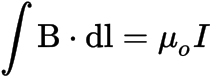
Canto: You want more bamboozlement? Here’s another version of Ampère’s law:
The integral around a closed path of the component of the magnetic field tangent to the direction of the path equals μ0 times the current intercepted by the area within the path.
The magnetic field created by an electric current is proportional to the size of that electric current with a constant of proportionality equal to the permeability of free space.
Canto: The symbol in in the equation above, (μ0), is a physical constant used in electromagnetism. It refers to the permeability of free space. My guess is that it wasn’t defined that way by Ampère.
Jacinta: I understand precisely nothing about that equation. Please tell me what an integral is, as if that might provide enlightenment.
Canto: It’s about quantifying areas defined by or under curves. And a tangent – but let’s not get into the maths.
Jacinta: But we have to!
Canto: Well, briefly for now, a tangent in maths can sort of mean more than one thing, I think. If you picture a circle, a tangent is a straight line that touches once the circumference of the circle. So that straight line could be horizontal, vertical or anything in between.
Jacinta: Right. And how does that relate to electromagnetism?
Canto: Okay, let’s return to Ampère’s experiment. Two parallel wires attracted each other when their currents were running in the same direction, and repelled each other when they were running in the opposite direction. It’s also the case – and I don’t know if this was discovered by Ampère, but never mind – that if you coil up a wire (carrying a current), the inside of the coil acts like a magnet, with a north and south pole. Essentially, what is happening is that the current in a wire creates a magnetic field around it, circling in a particular direction – either clockwise or anti-clockwise. The magnetic field is ‘stronger’ the closer it is to the wire. So there’s clearly a relationship between distance from the wire and field strength. And there’s also a relationship between field strength and the strength of the current in the wire. It’s those relations, which obviously can be mathematised, that are the basis of Ampère’s Law. So here’s another definition – hopefully one easier to follow:
The equation for Ampère’s Law applies to any kind of loop, not just a circle, surrounding a current, no matter how many wires there are, or how they’re arranged or shaped. The law is valid as long as the current is constant.
That’s the easy part, and then there’s the equation, which I’ll repeat here, and try to explain:
reading matters 1

The universe within by Neil Turok (theoretical physicist extraordinaire)
Content hints
– Massey Lectures, magic that works, the ancient Greeks, David Hume and the Scottish Enlightenment, James Clerk Maxwell, quantum mechanics, entanglement, expanding and contracting universes, the square root of minus one, mathematical science in Africa, Paul Dirac, beauty and knowledge, the vitality of uncertainty, Mary Shelley, quantum computing, digital and analogue, Richard Feynman, science and humanity, humility, education, love, collaboration, creativity and thrill-seeking.
On electrickery, part 1 – the discovery of electrons

Canto: This could be the first of a thousand-odd parts, because speaking for myself it will take me several lifetimes to get my head around this stuff, which is as basic as can be. Matter and charge and why is it so and all that.
Jacinta: so let’s start at random and go in any direction we like.
Canto: Great plan. Do you know what a cathode ray is?
Jacinta: No. I’ve heard of cathodes and anodes, which are positive and negative terminals of batteries and such, but I can’t recall which is which.
Canto: Don’t panic, Positive is Anode, Negative Is Cathode. Though I’ve read somewhere that the reverse can sometimes be true. The essential thing is they’re polar opposites.
Jacinta: Good, so a cathode ray is some kind of negative ray? Of electrons?
Canto: A cathode ray is defined as a beam of electrons emitted from the cathode of a high-vacuum tube.
Jacinta: That’s a pretty shitty definition, why would a tube, vacuum or otherwise, have a cathode in it? And what kind of tube? Rubber, plastic, cardboard?
Canto: Well let’s not get too picky. I’m talking about a cathode ray tube. It’s a sealed tube, obviously, made of glass, and evacuated as far as possible. Sciencey types have been playing around with vacuums since the mid seventeenth century – basically since the vacuum pump was invented in 1654, and electrical experiments in the nineteenth century, with vacuum tubes fitted with cathodes and anodes, led to the discovery of the electron by J J Thomson in 1897.
Jacinta: So what do you mean by a beam of electrons and how is it emitted, and can you give more detail on the cathode, and is there an anode involved? Are there such things as anode rays?
Canto: I’ll get there. Early experiments found that electrostatic sparks travelled further through a near vacuum than through normal air, which raised the question of whether you could get a ‘charge’, or a current, to travel between two relatively distant points in an airless tube. That’s to say, between a cathode and an anode, or two electrodes of opposite polarity. The cathode is of a conducting material such as copper, and yes there’s an anode at the other end – I’m talking about the early forms, because in modern times it starts to get very complicated. Faraday in the 1830s noted a light arc could be created between the two electrodes, and later Heinrich Geissler, who invented a better vacuum, was able to get the whole tube to glow – an early form of ‘neon light’. They used an induction coil, an early form of transformer, to create high voltages. They’re still used in ignition systems today, as part of the infernal combustion engine
Jacinta: So do you want to explain what a transformer is in more detail? I’ve certainly heard of them. They ‘create high voltages’ you say. Qu’est-ce que ça veux dire?
Canto: Do you want me to explain an induction coil, a transformer, or both?
Jacinta: Well, since we’re talking about the 19th century, explain an induction coil.
Canto: Search for it on google images. It consists of a magnetic iron core, round which are wound two coils of insulated copper, a primary and secondary winding. The primary is of coarse wire, wound round a few times. The secondary is of much finer wire, wound many many more times. Now as I’ve said, it’s basically a transformer, and I don’t know what a transformer is, but I’m hoping to find out soon. Its purpose is to ‘produce high-voltage pulses from a low-voltage direct current (DC) supply’, according to Wikipedia.
Jacinta: All of this’ll come clear in the end, right?
Canto: I’m hoping so. When a current – presumably from that low-volage DC supply – is passed through the primary, a magnetic field is created.
Jacinta: Ahh, electromagnetism…
Canto: And since the secondary shares the core, the magnetic field is also shared. Here’s how Wikipedia describes it, and I think we’ll need to do further reading or video-watching to get it clear in our heads:
The primary behaves as an inductor, storing energy in the associated magnetic field. When the primary current is suddenly interrupted, the magnetic field rapidly collapses. This causes a high voltage pulse to be developed across the secondary terminals through electromagnetic induction. Because of the large number of turns in the secondary coil, the secondary voltage pulse is typically many thousands of volts. This voltage is often sufficient to cause an electric spark, to jump across an air gap (G) separating the secondary’s output terminals. For this reason, induction coils were called spark coils.
Jacinta: Okay, so much for an induction coil, to which we shall no doubt return, as well as to inductors and electromagnetic radiation. Let’s go back to the cathode ray tube and the discovery of the electron.
Canto: No, I need to continue this, as I’m hoping it’ll help us when we come to explaining transformers. Maybe. A key component of the induction coil was/is the interruptor. To have the coil functioning continuously, you have to repeatedly connect and disconnect the DC current. So a magnetically activated device called an interruptor or a break is mounted beside the iron core. It has an armature mechanism which is attracted by the increasing magnetic field created by the DC current. It moves towards the core, disconnecting the current, the magnetic field collapses, creating a spark, and the armature springs back to its original position. The current is reconnected and the process is repeated, cycling through many times per second.

A Crookes tube showing green fluorescence. The shadow of the metal cross on the glass showed that electrons travelled in straight lines
Jacinta: Right so now I’ll take us back to the cathode ray tube, starting with the Crookes tube, developed around 1870. When we’re talking about cathode rays, they’re just electron beams. But they certainly didn’t know that in the 1870s. The Crookes tube, simply a partially evacuated glass tube with cathode and anode at either end, was what Rontgen used to discover X-rays.
Canto: What are X-rays?
Jacinta: Electromagnetic radiation within a specific range of wavelengths. So the Crookes tube was an instrument for exploring the properties of these cathode rays. They applied a high DC voltage to the tube, via an induction coil, which ionised the small amount of air left in the tube – that’s to say it accelerated the motions of the small number of ions and free electrons, creating greater ionisation.

x-rays and the electromagnetic spectrum, taken from an article on the Chandra X-ray observatory
Canto: A rapid multiplication effect called a Townsend discharge.
Jacinta: An effect which can be analysed mathematically. The first ionisation event produces an ion pair, accelerating the positive ion towards the cathode and the freed electron toward the anode. Given a sufficiently strong electric field, the electron will have enough energy to free another electron in the next collision. The two freed electrons will in turn free electrons, and so on, with the collisions and freed electrons growing exponentially, though the growth has a limit, called the Raether limit. But all of that was worked out much later. In the days of Crookes tubes, atoms were the smallest particles known, though they really only hypothesised, particularly through the work of the chemist John Dalton in the early nineteenth century. And of course they were thought to be indivisible, as the name implies.
Canto: We had no way of ‘seeing’ atoms in those days, and cathode rays themselves were invisible. What experimenters saw was a fluorescence, because many of the highly energised electrons, though aiming for the anode, would fly past, strike the back of the glass tube, where they excited orbital electrons to glow at higher energies. Experimenters were able to enhance this fluorescence through, for example, painting the inside walls of the tube with zinc sulphide.
Jacinta: So the point is, though electrical experiments had been carried out since the days of Benjamin Franklin in the mid-eighteenth century, and before, nobody knew how an electric current was transmitted. Without going into much detail, some thought they were carried by particles (like radiant atoms), others thought they were waves. J J Thomson, an outstanding theoretical and mathematical physicist, who had already done significant work on the particulate nature of matter, turned his attention to cathode rays and found that their velocity indicated a much lighter ‘element’ than the lightest element known, hydrogen. He also found that their velocity was uniform with respect to the current applied to them, regardless of the (atomic) nature of the gas being ionised. His experiments suggested that these ‘corpuscles’, as they were initially called, were 1000 times lighter than hydrogen atoms. His work was clearly very important in the development of atomic theory – which in large measure he initiated – and he developed his own ‘plum pudding’ theory of atomic structure.
Canto: So that was all very interesting – next time we’ll have a look at electricity from another angle, shall we?
So why exactly is the sky blue? SfD tries to investigate
Canto: Well, Karl Kruszelnicki is one of our best science popularisers as you know, and therefore a hero of ours, but I have to say his explanation of the blueness of our daily sky in his book 50 Shades of Grey left me scratching my head…
Jacinta: Not dumbed-down enough for you? Do you think we could form a Science for Dummies collaboration to do a better job?
Canto: Well that would really be the blind leading the blind, but at least we’d inch closer to understanding if we put everything in our own words… and that’s what I’m always telling my students to do.
Jacinta: So let’s get down to it. The day-sky is blue (or appears blue to we humans?) because…?
Canto: Well the very brief explanation given by Dr Karl is that it’s about Rayleigh scattering. Named for a J W Strutt, aka Lord Rayleigh, who first worked it out.
Jacinta: So let’s just call it scattering. What’s scattering?
Canto: Or we might call it light scattering. Our atmosphere is full of particles, which interfere with the light coming to us from the sun. Now while these particles are all more or less invisible to the naked eye, they vary greatly in size, and they’re also set at quite large distances from each other, relative to their size. The idea, broadly, is that light hits us from the sun, and that’s white light, which as we know from prisms and rainbows is made up of different wavelengths of light, which we see, in the spectrum that’s visible to us, as Roy G Biv, red orange yellow green blue indigo violet, though there’s more of some wavelengths or colours than others. Red light, because it has a longer wavelength than blue towards the other end of the spectrum, tends to come straight through from the sun without hitting too many of those atmospheric particles, whereas blue light hits a lot more particles and bounces off, often at right angles, and kind of spreads throughout the sky, and that’s what we mean by scattering. The blue light, or photons, bounce around the sky from particle to particle before hitting us in the eye so to speak, and so we see blue light everywhere up there. Now, do you find that a convincing explanation?
Jacinta: Well, partly, though it raises a lot of questions.
Canto: Excellent. That’s science for you.
Jacinta: You say there are lots of particles in the sky. Does the size of the particle matter? I mean, I would assume that the light, or the photons, would be more likely to hit large particles than small ones, but that would depend on just how many large particles there are compared to small ones. Surely our atmosphere is full of molecular nitrogen and oxygen, mostly, and they’d be vastly more numerous than large dust particles. Does size matter? And you say that blue light, or blue photons, tend to hit these particles because of their shorter wavelengths. I don’t quite get that. Why would something with a longer wavelength be more likely to miss? I think of, say, long arrows and short arrows. I see no reason why a longer arrow would tend to miss the target particles – not that they’re aiming for them – while shorter arrows hit and bounce off. And what makes them bounce off anyway?
Canto: OMG what a smart kid you are. And I think I can add more to those questions, such as why do we see different wavelengths of light as colours anyway, and why do we talk sometimes of waves and sometimes of particles called photons? But let’s start with the question of whether size matters. All I can say here is that it certainly does, but a fuller explanation would be beyond my capabilities. For a start, the particles hit by light are not only variable by size but by shape, and so potentially infinite in variability. Selected geometries of particles – for example spherical ones – can yield solutions as to light scattering based on the equations of Maxwell, but that doesn’t help much with random dust and ice particles. Rayleigh scattering deals with particles much smaller than the light’s wavelength but many particles are larger than the wavelength, and don’t forget light is a bunch of different wavelengths, striking a bunch of different sized and shaped particles.
Jacinta: Sounds horribly complex, and yet we get this clear blue sky. Are you ready to give up now?
Canto: Just about, but let me tackle this bouncing off thing. Of course this happens all the time, it’s called reflection. You see your reflection in the mirror because mirrors are designed as highly reflective surfaces.
Jacinta: Highly bounced-off. So what would a highly unreflective surface look like?
Canto: Well that would be something that lets all the light through without reflection or distortion, like the best pane of glass or pair of specs. You see the sky as blue because all these particles are absorbing and reflecting light at particular wavelengths. That’s how you see all colours. As to why things happen this way, OMG I’m getting a headache. The psychologist Thalma Lobel highlights the complexity of it all this way:
A physicist would tell you that colour has to do with the wavelength and frequency of the beams of light reflecting and scattering off a surface. An ophthalmologist would tell you that colour has to do with the anatomy of the perceiving eye and brain, that colour does not exist without a cornea for light to enter and colour-sensitive retinal cones for the light-waves to stimulate. A neurologist might tell you that colour is the electro-chemical result of nervous impulses processed in the occipital lobe in the rear of the brain and translated into optical information…
Jacinta: And none of these perspectives would contradict the others, it would all fit into the coherence theory of truth…
Canto: Not truth so much as explanation, which approaches truth maybe but never gets there, but the above quote gives a glimpse of how complex this matter of light and colour really is…
Jacinta: And just on the physics, I’ve looked at a few explanations online, and they don’t satisfy me.
Canto: Okay, I’m going to end with another quote, which I’m hoping may give you a little more satisfaction. This is from Live Science.
The blueness of the sky is the result of a particular type of scattering called Rayleigh scattering, which refers to the selective scattering of light off of particles that are no bigger than one-tenth the wavelength of the light.
Importantly, Rayleigh scattering is heavily dependent on the wavelength of light, with lower wavelength light being scattered most. In the lower atmosphere, tiny oxygen and nitrogen molecules scatter short-wavelength light, such as blue and violet light, to a far greater degree than long-wavelength light, such as red and yellow. In fact, the scattering of 400-nanometer light (violet) is 9.4 times greater than the scattering of 700-nm light (red).
Though the atmospheric particles scatter violet more than blue (450-nm light), the sky appears blue, because our eyes are more sensitive to blue light and because some of the violet light is absorbed in the upper atmosphere.
Jacinta: Yeah so that partially answers some of my questions… ‘selective scattering’, there’s something that needs unpacking for a start…
Canto: Well, keep asking questions, smart ones as well as dumb ones…
Jacinta: Hey, there are no dumb questions. Especially from me. Remember this is supposed to be science for dummies, not science by dummies.
Canto: Okay then. So maybe we should quit now, before we’re found out…
References:
‘Why is the sky blue?’, from 50 shades of grey matter, Karl Kruszelnicki, pp15-19
‘Blue skies smiling at me: why the sky is blue’, from Bad astronomy, Philip Plait, pp39-47
http://www.livescience.com/32511-why-is-the-sky-blue.html
Einstein, science and the natural world: a rabid discourse

Einstein around 1915
Canto: Well, we’re celebrating this month what is surely the greatest achievement by a single person in the history of science, the general theory of relativity. I thought it might be a good time to reflect on that achievement, on science generally, and on the impetus that drives us to explore and understand as fully as possible the world around us.
Jacinta: The world that made us.
Canto: Précisément.
Jacinta: Well, first can I speak of Einstein as a political animal, because that has influenced me, or rather, his political views seem to chime with mine. He’s been described as a supra-nationalist, which to me is a kind of political humanism. We’re moving very gradually towards this supra-nationalism, with the European Union, the African Union, and various intergovernmental and international organisations whose goals are largely political. Einstein also saw the intellectual venture that is science as an international community venture, science as an international language, and an international community undertaking. And with the development of nuclear weapons, which clearly troubled him very deeply, he recognised more forcefully than ever the need for us to take international responsibility for our rapidly developing and potentially world-threatening technology. In his day it was nuclear weapons. Today, they’re still a threat – you’ll never get that genie back in the bottle – but there are so many other threats posed by a whole range of technologies, and we need to recognise them, inform ourselves about them, and co-operate to reduce the harm, and where possible find less destructive but still effective alternatives.
Canto: A great little speech Jas, suitable for the UN general assembly…
Jacinta: That great sinkhole of fine and fruitless speeches. So let’s get back to general relativity, what marks it off from special relativity?
Canto: Well I’m not a physicist, and I’m certainly no mathematician, but broadly speaking, general relativity is a theory of gravity. Basically, after developing special relativity, which dealt with the concepts of space and time, in 1905, he felt that he needed a more comprehensive relativistic theory incorporating gravity.
Jacinta: But hang on, was there really anything wrong with space and time before he got his hands on them? Why couldn’t he leave them alone?
Canto: OMG, you’re taking me right back to basics, aren’t you? If I had world enough, and time…
Jacinta: Actually the special theory was essentially an attempt – monumentally successful – to square Maxwell’s electromagnetism equations with the laws of Newton, a squaring up which involved enormous consequences for our understanding of space and time, which have ever since been connected in the concept – well, more than a concept, since it has been verified to the utmost – of the fourth, spacetime, dimension.
Canto: Well done, and there were other vital implications too, as expressed in E = mc², equivalating mass and energy.
Jacinta: Is that a word?
Canto: It is now.
Jacinta: So when can we stop pretending that we understand any of this shite?
Canto: Not for a while yet. The relevance of relativity goes back to Galileo and Newton. It all has to do with frames of reference. At the turn of the century, when Einstein was starting to really focus on this stuff, there was a lot of controversy about whether ‘ether’ existed – a postulated quasi-magical invisible medium through which electromagnetic and light waves propagated. This ether was supposed to provide an absolute frame of reference, but it had some contradictory properties, and seemed designed to explain away some intractable problems of physics. In any case, some important experimental work effectively quashed the ether hypothesis, and Einstein sought to reconcile the problems by deriving special relativity from two essential postulates, constant light speed and a ‘principle of relativity’, under which physical laws are the same regardless of the inertial frame of reference.

the general theory – get it?
Jacinta: What do you mean, ‘the initial frame of reference’?
Canto: No, I said ‘the inertial frame of reference’. That’s one that describes all parameters homogenously, in such a way that any such frame is in a constant motion with respect to other such frames. But I won’t go into the mathematics of it all here.
Jacinta: As if you could.
Canto: Okay. Okay. I won’t go any further in trying to elucidate Einstein’s work, to myself, you or anyone else. At the end of it all I wanted to celebrate the heart of Einstein’s genius, which I think represents the best and most exciting element in our civilisation.
Jacinta: Drumroll. Now, expose this heart to us.
Canto: Well we’ve barely touched on the general theory, but what Einstein’s work on gravity teaches us is that by not leaving things well alone, as you put it, we can make enormous strides. Of course it took insight, hard work, and a full and deep understanding of the issues at stake, and of the work that had already been done to resolve those issues. And I don’t think Einstein was intending to be a revolutionary. He was simply exercised by the problems posed in trying to understand, dare I say, the very nature of reality. And he rose to that challenge and transformed our understanding of reality more than any other person in human history. It’s unlikely that anything so transformative will ever come again – from the mind of a single human being.
Jacinta: Yes it’s an interesting point, and it takes a particular development of culture to allow that kind of transformative thinking. It took Europe centuries to emerge from a sort of hegemony of dogmatism and orthodoxy. During the so-called dark ages, when warfare was an everyday phenomenon, and later too, right through to the Thirty Years War and beyond, one thing that could never be disputed amongst all that disputation was that the Bible was the word of God. Nowadays, few people believe that, and that’s a positive development in the evolution of culture. It frees us to look at morality from a broader, richer, extra-Biblical perspective..
Canto: Yes we no longer have to even pretend that our morality comes from such sources.
Jacinta: Yes and I’m thinking of other parts of the world that are locked in to this submissive way of thinking. A teaching colleague, an otherwise very liberal Moslem, told me the other day that he didn’t believe in gay marriage, because the Qu-ran laid down the law on homosexuals, and the Qu-ran, because written by God, is perfect. Of course I had to call BS on that, which made me quite sad, because I get on very well with him, on a professional and personal basis. It just highlights to me the crushing nature of culture, how it blinds even the best people to the nature of reality.
Canto: Not being capable of questioning, not even being aware of that incapability, that seems to me the most horrible blight, and yet as you say, it wasn’t so long ago that our forebears weren’t capable of questioning the legitimacy of Christianity’s ‘sacred texts’, in spite of interpreting those remarkably fluid texts in myriad ways.
Jacinta: And yet out of that bound-in world, modern science had its birth. Some modern atheists might claim the likes of Galileo and Francis Bacon as one of their own, but none of our scientific pioneers were atheists in the modern sense. Yet the principles they laid down led inevitably to the questioning of sacred texts and the gods described in them.
Canto: Of course, and the phenomenal success of the tightened epistemology that has produced the scientific and technological revolution we’re enjoying now, with exoplanets abounding, and the revelations of Homo floresiensis, Homo naledi and the Denisovan hominin, and our unique microbiome, and recent work on the interoreceptive tract leading to to the anterior insular cortex, and so on and on and on, and the constant shaking up of old certainties and opening up of new pathways, all happening at a giddying accelerating rate, all of this leaves the ‘certainty of faith’ looking embarrassingly silly and feeble.
Jacinta: And you know why ‘I fucking love science’, to steal someone else’s great line? It’s not because of science itself, that’s only a means. It’s what it reveals about our world that’s amazing. It’s the world of stuff – animate and inanimate – that’s amazing. The fact that this solid table we’re sitting at is made of mostly empty space – a solidity consisting entirely of electrochemical bonds, if that’s the right term, between particles we can’t see but whose existence has been proven a zillion times over, and the fact that as we sit here on a still, springtime day, with a slight breeze tickling our faces, we’re completely oblivious of the fact that we hurtling around on the surface of this earth, making a full circle every 24 hours, at a speed of nearly 1700 kms per hour. And at the same time we’re revolving around the sun at a far greater speed, 100,000 kms per hour. And not only that, we’re in a solar system that’s spinning around in the outer regions of our galaxy at around 800,000 kilometres an hour. And not only that… well, we don’t feel an effing thing. It’s the counter-intuitive facts about the natural world that our current methods of investigation reveal – these are just mind-blowing. And if your mind doesn’t get blown by it, then you haven’t a mind worth blowing.
Canto: And we have two metres of DNA packed into each nucleus of the trillions of cells in our body. Who’d’ve thunkit?

whatever