Posts Tagged ‘light’
trying to understand special relativity – what fun!?

What?
Always being overly ambitious, and often reading stuff that’s beyond my ken, but perhaps not too far beyond, I read with intriguement this sentence from Sean Carroll’s book The Big Picture:
Einstein’s special relativity (as opposed to general relativity) is the theory that melds space and time together and posits the speed of light as an absolute limit on the universe .
Yeah, everybody who’s anybody knows that, so meet Mr Nobody. But I do try, sort of. Some months ago I bought Leonard Susskind’s Special Relativity and Classical Field Theory, read the first ten pages and then…
Anyway, I’ve still got the book. What I really need is my own personal tutor, who’ll drive the understanding into me, like a nail into diamond…
Susskind points out in his introduction that special relativity (SR) ‘is generally regarded as a branch of classical physics’, which is presumably his way of saying it’s not as much of a brainfuck as general relativity. It’s essentially derived from Maxwell’s work on electromagnetism and the constancy of the speed of light, and on the first page of the introduction I’m given this reassurance:
Some basic grounding in calculus and linear algebra should be good enough to get you through.
So I know that linear algebra has to do with lines and symbols, and calculus has something to do with teeth, so I suppose I’m halfway there.
Seriously, the concept of relativism, that all motion is relative, goes back to Galileo and Newton, and yet Maxwell, who introduced field theory to science, in the form of electromagnetic theory, predicted (via this theory, somehow) that light had a distinct, non-referential velocity – c = 299,792,458 metres per second, pretty much. Considering that we know of and can imagine many different frames of reference, this doesn’t seem to make sense. The concept of ether – the dark energy of the 19th century? – was hypothesised to somehow regularise the situation, as a possible medium through which light was ‘carried’. This sort of meant that no vacuum was really a vacuum, but rather a plenum of ether. The trouble with this concept was that it remained a concept, pretty much untestable. So in 1887 a famous experiment was carried out – the Michelson-Morley experiment, as an attempt to detect and capture the properties of ether. But, having sent the waves of light backwards, forwards, sideways, down, they could detect no difference in the speed (Wikipedia’s entry on the Michelson-Morley experiment, its background and subsequent experiments, and the effect upon Einstein, etc, etc, is comprehensive, complex and more than enough to make me wonder why I’m tackling this topic).
Anyway none of these experiments revealed anything like luminiferous ether, and all found no change in light’s speed, no matter how much they tried to torture it. At least I think that’s the case – experiments did get conflicting results, and Wikipedia describes it all in terms of mathematical equations that, sadly, are an alien language to me. All I’m really sure of is that the ether concept was pretty well debunked before Einstein came along. I believe Hendrik Lorentz, with his transformations, played a major role here.
So now I’ll switch to Sabine Hossenfelder’s video on special relativity, in the hope of achieving Enlightenment. Einstein’s idea of space-time, with time being a fourth dimension added to three-dimensional space, was first suggested by the brilliant mathematician Hermann Minkowski, but it was Einstein who built on his work, together with that of Lorentz and Henri Poincaré, to revolutionise our understanding of how our world, or universe, actually is. My feeling, which could be wrong, is that those other mathematicians were just doing mathematics, in the usual abstract way that mathematicians go about things, while Einstein recognised the real world applications – to put it over-simplistically, no doubt.
How all this relates to the famous E = mc² equation, I’m not sure, but it all brings back a childhood memory. I was in the back seat of the family car, driving along a freeway, with my two older siblings beside me. My guess is that I was around eight or nine. One of them said, something like, ‘well, if we go any faster we’ll start to lose weight, our mass will turn into energy, and if we get to the speed of light, we’ll disappear altogether, as Einstein says…’. Needless to say, I found this most discombobulating, but also intriguing. And I still do. That equation obviously relates mass and energy, but it relates these two variables to the square of a constant, c, the speed of light, a speed beyond which nothing can travel!?
So okay, I’ll return to Hossenfelder in a mo, and cite a little ‘nutshell’ piece from PBS, ‘Einstein’s Big Idea’:
Why… do you have to square the speed of light? It has to do with the nature of energy. When something is moving four times as fast as something else, it doesn’t have four times the energy but rather 16 times the energy—in other words, that figure is squared. So the speed of light squared is the conversion factor that decides just how much energy lies within a walnut or any other chunk of matter. And because the speed of light squared is a huge number—90,000,000,000 (km/sec)2—the amount of energy bound up into even the smallest mass is truly mind-boggling.
That almost makes me feel ashamed – I have far more energy bound up in me than in a walnut, so why do I feel so tired?
But Hossenfelder focuses on the space-time connection. Spatial co-ordinates are obviously very useful for locating everything, and for map-making. But those co-ordinates won’t tell us how to get to a destination in the least time. After all, there may be many pathways to take. But what Hossenfelder says next is a bit confusing:
If time becomes a co-ordinate, the same happens to time. If you give me your co-ordinates in space and in time, I will know where and when to find you. But the co-ordinates don’t tell me the length of the path that brings me to you, and they also don’t tell me how long it’ll take me to get there. But wait… if it’s 5am now, and I tell you we’re meeting at 5pm, then that’ll take 12 hours, right? No, wrong. Those 12 hours are your co-ordinate time. They are just convenient markers. They’re convenient for you because they agree with the time that actually passes for you. But how much time passes for me while I get to our meeting depends on how I get there. It’s just that the difference between the passage of your time and my time as I come to meet you is normally so small that we don’t notice. It would only become noticeable if I was moving close to the speed of light…
The numerous comments on Sabine’s video, to the effect that it’s the best explanation of special relativity they’ve ever heard, that at last they fully understand it, etc, fill me with whole teaspoonfuls of despair. What I think this passage means is that the wrongness of the 12 hours passing between one person and another vis-à-vis their meeting is a very very tiny wrongness due to the relatively small distance between them measured in relation to light-speed. I find it hard to call it wrong at all, but then I’m not light years away from anyone I know.
Co-ordinate time, which Sabine dismisses as a convenient marker, is surely the only time that matters for us non-physicist plebs, who are never going to consider the speed of light when making appointments. So…
It matters, I realise, if we planned to meet in a different galaxy, one in my neighbourhood but not in yours. So… let’s leave that one for now.
So now we have four dimensions, which clearly can’t be easily presented on a screen. On Sabine’s two-dimensional graph, representing space (x), time (y) and space-time (somewhere/everywhere), an immobile me can apparently be represented by a straight vertical line. Movement at constant velocity requires an angled line, with the speed of light conventionally set at 45 degrees. So far, so straightforward, almost, but then the bamboozling comes in, at least for me.
Space-time differs from space in one crucial way, which is how you calculate distances in it. If you have two dimensions of space, one called x and the other y, then calculating the length of a straight line between them is straightforward. You take the distances between the co-ordinate labels of x (call that delta x) and the same for y (call that delta y)…
That can be presented in an equation. I’m more or less allergic to even the simplest equations, and I’m doing Brilliant.org to cure myself. Not cured yet. Anyway,
Δ x = x2 − x1 and Δy = y2 − y1
The distance between the points (the Euclidean distance – which Sabine claims she learned in kindergarten – I hate her!) is the square root of the sum of the squares.
d = √[ (x – x)2 + (y – y)2] – (I couldn’t find an equation using the delta symbol, but I think I get it).
So, of course, space-time is quite different. There, we deal with co-ordinates in space and time, known as ‘events’. So, an extra layer of complexity. With two events, ‘each with a position in x and a time in t, and you want to calculate the space-time distance between them, then again you take the differences between the co-ordinate labels (Δ x and ∆ t). Then, as Sabine tells me, you take the square root of the square of ∆ t minus the square of Δ x divided by c (the speed of light). This is called the Lorentzian Distance, and the minus is apparently what it’s all about. It makes everything work out.
So, I’m not sure if I’m understanding this but I need to continue. So if you pick at random a reference point, say (0,0) and you map all points equidistant from that origin (in 2 dimensional space), you’ll map a circle. Different distances measured in these equidistant ways will map out circles with different radii. But, rather mind-blowingly, if we switch to space-time, ‘then all points at the same space-time distance from the origin are hyberbolae. You can’t move on those lines because that’d require you to move faster than light’. But you can move on the axes (according to Sabine), which would require a constant acceleration. I don’t understand this. Do I just have to accept it, like religious people have to accept their gods? Anyway, I’ll quote Sabine again:
The key to understanding space-time is now this. The time that passes for an observer moving on any curve in space-time is the length of that curve, calculated using this peculiar notion of Lorentzian distance that we just discussed. It’s called the ‘proper time’. It’s the proper way of calculating time according to Einstein. If you move between two events at a constant velocity, then the time which passes on the way is… the square root of ∆ t squared minus Δ x divided by c squared.
Okay, I’m waiting for a light-bulb moment, but I seem to be short of electricity. The ‘proper time’ is further defined as ‘the length of a curve in space-time’ and/or ‘the time that passes on that curve’. But why is this so? And why these hyperbolae? Something to do with space-time curvature perhaps?
Anyhow, let’s continue. If you’re not moving at a constant velocity, a more likely scenario, you break up the line into small pieces of straightness, sum them and ‘integrate over the curve’ (which I actually think I understand)….
One thing you shouldn’t do is confuse the co-ordinate time with the proper time. I must remember that…
But I’ve written enough, and I’ve had no Eureka moment. More later, perhaps.
References
Sean Carroll, The Big Picture, 2016
Leonard Susskind/Art Friedman, Special Relativity & Classical Field Theory: the Theoretical Minimum, 2017
https://en.wikipedia.org/wiki/Michelson–Morley_experiment
advancing solar, the photovoltaic effect, p-type semiconductors and the fiendishness of human manipulation

how to enslave electrons – human, all too human – stolen from E4U
Canto: Back to practical stuff for now (not that integral calculus isn’t practical), and the efficiencies in solar panels among other green technologies. Listening to podcasts such as those from SGU and New Scientist while walking the dog isn’t the best idea, what with doggy distractions and noise pollution from ICEs, so we’re going to take some of the following from another blog, Neurologica, which was also summarised on a recent SGU podcast.
Jacinta: Yes it’s all about improvements in solar panels, and the materials used in them, over the past couple of decades. We’re talking about improvements in lifespan and overall efficiency, not to mention cost to the consumer. Your standard silicon solar panels have improved efficiency since the mid 2000s from around 11% to around 28% – something like a 180% improvement. Is that good maths? Anyway, it’s the cheapest form of new energy and will become cheaper. And there’s also perovskite for different solar applications, and the possibility of quantum hi-tech approaches, using advanced AI technology to sort out the most promising. So the future is virtually impossible for we mere humans to predict.
Canto: Steven Novella, high priest of the SGU and author of the Neurologica post, suggests that with all the technological focus in this field today, who knows what may turn up – ‘researchers are doing amazing things with metamaterials’. He takes a close look at organic solar cells in particular, but these could possibly be combined with silicon and perovskite in the future. Organic solar cells are made from carbon-based polymers, essentially forms of plastic, which can be printed on various substrates. They’re potentially very cheap, though their life-span is not up to the silicon crystal level. However, their flexibility will suit applications other than rooftop solar – car roofs for example. They’re also more recyclable than silicon, which kind of solves the life-span problem. Their efficiency isn’t at the silicon level either, but that of course may change with further research. Scaling up production of these flexible organic solar materials has already begun.
Jacinta: So, I’ve mentioned perovskite, and I barely know what I’m talking about. So… some basic research tells me it’s a calcium titanium oxide mineral composed of calcium titanate (chemical formula CaTiO3), though any material with the ‘perovskite structure’ can be so called. It’s found in the earth’s mantle, in some chondritic meteorites, ejected limestone deposits and in various isolated locations such as the Urals, the Kola Peninsula in Russia, and such other far-flung places as Sweden and Arkansas. But I think the key is in the crystalline structure, which can be found in a variety of compounds.
Canto: Yes, worth watching perovskite developments in the future. I’m currently watching a video from Real Engineering called ‘the mystery flaw of solar panels’, which argues that this flaw has been analysed and solutions are being found. So, it starts with describing the problem – light-induced degradation, and explaining the photovoltaic effect:
The photovoltaic effect is the generation of voltage and electric current in a material upon exposure to light. It is a physical and chemical phenomenon.
Jacinta: Okay can we get clear again about the difference between voltage and current? I know that one is measured in volts and the other in amps but that explains nout.
Canto: Well, here’s one explanation – voltage, or emf, is the difference in electric potential between one point and another. Current is the rate of flow of an electric charge at any particular point. Check the references for more detail on that. Anyway we really are in the middle of a solar revolution, but the flaw in current solar panels is that newly manufactured solar cells are being tested at a little over 20% efficiency, that’s to say, 20% of the energy input from the sun is being converted into electric current. But within hours of operation the efficiency drops to 18% or so. That’s a 10% drop in generation, which becomes quite substantial on a large scale, with solar farms and such. So this is the problem of light-induced degradation, as mentioned. So, to quote the engineering video, ‘[the photovoltaic effect] is where photons of a particular threshold frequency, striking a material, can cause electrons to gain enough energy to free them from their atomic orbits and move freely in the material’. Semiconductors, which are sort of halfway between conductors and insulators, are the best materials for making this happen.
Jacinta: That’s strange, or counter-intuitive. Wouldn’t conductors be the best for getting electrons moving? Isn’t that why we use copper in electric wiring?
Canto: That’s a good question, which we might come back to. The first semiconducting material used, back in the 1880s, was (very expensive) selenium, which managed to create a continuous current with up to 1% efficiency. And so, silicon.
Jacinta: Which is essentially what we use, in inedible chip form, in all our electronic devices. Pretty versatile stuff. Will we always have enough of it?
Canto: Later. So when light hits this silicon crystal material, it can either be reflected, absorbed or neither – it may pass through without effect. Only absorption creates the photovoltaic effect. So, to improve efficiency we need to enhance absorption. Currently 30% of light is reflected from untreated silicon panels. If this wasn’t improved, maximum efficiency could only reach 70%. So we treat the panels with a layer of silicon monoxide reducing reflection to 10%. Add to that a layer of titanium dioxide, taking reflection to as low as 3%. A textured surface further enhances light absorption – for example light might be reflected sideways and hit another bump, where it’s absorbed. Very clever. But even absorbed light only has the potential to bring about the photovoltaic effect.
Jacinta: Yes, in order to create the effect, that is, to get electrons shifted, the photon has to be above a certain energy level, which is interesting, as photons aren’t considered to have mass, at least not when they’re at rest, but I’m not sure if photons ever rest… As the video says, ‘a photon’s energy is defined by multiplying Planck’s constant by its frequency’. That’s E = h.f, where h is Planck’s constant, which has been worked out by illustrious predecessors as 6.62607015 × 10⁻³⁴ joule-seconds, according to the International System of Units (SI). And with silicon, the photons need an electromotive force of 1.1 electron volts to produce the photovoltaic effect, which can be converted, apparently, to a wavelength of 1,110 nanometres. That’s in the infrared, on the electromagnetic spectrum, near visible light. Any lower, in terms of energy (the lower the energy, the lower the frequency, the longer the wavelength, I believe), will just create heat and little light, a bit like my brain.
Canto: I couldn’t possibly comment on that, but the video goes on to explain that the solar energy we get from the sun, shown on a graph, is partially absorbed by our atmosphere before it reaches our panels. About 4% of the energy reaching us is in the ultraviolet, 44% is in the visible spectrum and 52% is in the infrared, surprisingly enough. Infrared red light has lower energy than visible light but it has a wider spectrum so the total energy emitted is greater. Now, silicon cannot use light above 1,110 nms in wavelength, meaning that some 19% of the sun’s energy can’t be used by our panels.
Jacinta: Yes, and another thing we’re supposed to note is that higher energy light doesn’t release more electrons, just higher energy electrons…
Canto: And presumably they’re talking about the electrons in the silicon structure?
Jacinta: Uhh, must be? So blue light – that’s at the short-wavelength end of the visible spectrum – blue light has about twice the energy of red light, ‘but the electrons that blue light releases simply lose their extra energy in the form of heat, producing no extra electricity. This energy loss results in about 33% of sunlight’s energy being lost.’ So add that 33% to the 19% lost at the long-wavelength end, that’s 52% of potential energy being lost. These are described as ‘spectrum losses’.
Canto: Which all sounds bad, but silicon, or its reaction with photons, has a threshold frequency that ‘balances these two frequency losses’. So, it captures enough of the low-energy wavelengths (the long wavelengths beyond the infra-red), while not losing too much efficiency due to heat. The heat problem can be serious, though, requiring active cooling in some climates, thus reducing efficiency in a vicious circle of sorts. Still, silicon is the best of threshold materials we have, presumably.
Jacinta: So, onto the next piece of physics, which is that there’s more to creating an electric current than knocking an electron free from its place in ye olde lattice, or whatever. For starters, ye olde electron just floats about like a lost lamb.
Canto: No use to anyone.
Jacinta: Yeah, it needs to be forced into doing work for us.
Canto: Because humans are arseholes who make slaves of everything that moves. Free the electrons!
Jacinta: You’ve got it. They need to be forced to work an electric circuit. And interestingly, the hole left when we’ve knocked an electron out of its happy home, that hole is also let loose to roam about like a lost thing. Free electrons, free holes, when they meet, they’re happy but the circuit is dead before it starts.
Canto: This sounds like a tragicomedy.
Jacinta: So we have to reduce the opportunities for electrons and holes to meet. Such is the cruelty of progress. For of course, we must needs use force, taking advantage of silicon’s unique properties. The most excellent crystal structure of the element is due to its having 4 electrons in its outer shell. So it bonds covalently with 4 other silicon atoms. And each of those bonds with 3 others and so on. A very stable balance. So the trick that we manipulative humans use to mess up this divine balance is to introduce impurities called dopants into the mix. If we add boron, which has 3 outer electrons, into the crystal lattice, this creates 3 covalent bonds with silicon, leaving – a hole!
Canto: How fiendishly clever!
Jacinta: It’s called a p-type trick, as it has this ‘positive’ hole just waiting for an electron to fill it. Sounds kind of sexy really.
Canto: Manipulation can be sexy in a perverse way. Stockholm syndrome for electrons?
Jacinta: Okay, there’s a lot more to this, but we’ve gone on long enough. I’ve had complaints that our blog posts are too long. Well, one complaint, because only one or two people read our stuff…
Canto: No matter – at least we’ve learned something. Let’s continue to rise above ourselves and grasp the world!
Jacinta: Okay, to be continued….
References
https://www.theskepticsguide.org/podcasts
https://news.mit.edu/2022/perovskites-solar-cells-explained-0715
The Mystery Flaw of Solar Panels (Real Engineering video)
https://byjus.com/physics/difference-between-voltage-and-current/
what is electricity? part 10 – it’s some kind of energy

je ne sais pas
Canto: We’ve done nine posts on electricity and it still seems to me like magic. I mean it’s some kind of energy produced by ionisation, which we’ve been able to harness into a continuous flow, which we call current. And the flow can alternate directionally or not, and there are advantages to each, apparently.
Jacinta: And energy is heat, or heat is energy, and can be used to do work, and a lot of work has been done on energy, and how it works – for example there’s a law of conservation of energy, though I’m not sure how that works.
Canto: Yes maybe if we dwell on that concept, something or other will become clearer. Apparently energy can’t be created or destroyed, only converted from one form to another. And there are many forms of energy – electrical, gravitational, mechanical, chemical, thermal, whatever.
Jacinta: Muscular, intellectual, sexual?
Canto: Nuclear energy, mass energy, kinetic energy, potential energy, dark energy, light energy…
Jacinta: Psychic energy… Anyway, it’s stuff that we use to do work, like proteinaceous foodstuff to provide us with the energy to get ourselves more proteinaceous foodstuff. But let’s not stray too far from electricity. Electricity from the get-go was seen as a force, as was gravity, which Newton famously explained mathematically with his inverse square law.
Canto: ‘Every object or entity attracts every other object or entity with a force directly proportional to the product of their masses and inversely proportional to the square of the distance between their centres’, but he of course didn’t know how much those objects, like ourselves, were made up of a ginormous number of particles or molecules, of all shapes and sizes and centres of mass.
Jacinta: But the inverse square law, in which a force dissipates with distance, captured the mathematical imagination of many scientists and explorers of the world’s forces over the following generations. Take, for example, magnetism. It seemed to reduce with distance. Could that reduction be expressed in an inverse square law? And what about heat? And of course electrical energy, our supposed topic?
Canto: Well, some quick net-research tells me that magnetism does indeed reduce with the square of distance, as does heat, all under the umbrella term that ‘intensity’ of any force, if you can call thermal energy a force, reduces in an inverse square ratio from the point source in any direction. As to why, I’m not sure if that’s a scientific question.
Jacinta: A Khan Academy essay tackles the question scientifically, pointing out that intuition sort of tells us that a force like, say magnetism, reduces with distance, as does the ‘force’ of a bonfire, and that these reductions with distance might all be connected, and therefore quantified in the same way. The key is in the way the force spreads out in straight lines in every direction from the source. That’s how it dissipates. When you’re close to the source it hasn’t had a chance to spread out.
Canto: So when you’re measuring the gravitational force upon you of the earth, you have to remember that attractive force is pulling you to the earth’s centre of mass. That attractive force is radiating out in all directions. So if you’re at a height that’s twice the distance between the earth’s surface and its centre of mass, the force is reduced by a particular mathematical formula which has to do with the surface of a sphere which is much larger than the earth’s sphere (though the earth isn’t quite a sphere), but can be mathematically related to that sphere quite precisely, or to a smaller or larger sphere. The surface of a sphere increases with the square of the radius.
Jacinta: Yes, and this inverse square law works for light intensity too, though it’s not intuitively obvious, perhaps. Or electromagnetic radiation, which I think is the technical term. And the keyword is radiation – it radiates out in every direction. Think of spheres again. But we need to focus on electricity. The question here is – how does the distance between two electrically charged objects affect the force of attraction or repulsion between them?
Canto: Well, we know that increasing the distance doesn’t increase the force. In fact we know – we observe – that increasing the distance decreases the force. And likely in a precise mathematical way.
Jacinta: Well thought. And here we’re talking about electrostatic forces. And evidence has shown, unsurprisingly, that the decreased or increased force is an inverse square relationship. To spell it out, double the distance between two electrostatically charged ‘points’ decreases the force (of attraction or repulsion) by two squared, or four. And so on. So distance really matters.
Canto: Double the distance and you reduce the force to a quarter of what it was. Triple the distance and you reduce it to a ninth.
Jacinta: This is Coulomb’s law for electrostatic force. Force is inversely proportional to the square of the distance – 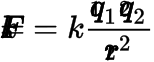 . Where F is the electric force, q are the two charges and r is the distance of separation. K is Coulomb’s constant.
Canto: Which needs explaining.
Jacinta: It’s a proportionality constant. This is where we have to understand something of the mathematics of variables and constants. So, Coulomb’s law was published by the brilliant Charles Augustin de Coulomb, who despite what you might think from his name, was no aristocrat and had to battle to get a decent education, in 1785. And as can be seen in his law, it features a constant similar to Newton’s gravitational constant.
Canto: So how is this constant worked out?
Jacinta: Well, think of the most famous equation in physics, E=mc2, which involves a constant, c, the speed of light in a vacuum. This speed can be measured in various ways. At first it was thought to be infinite, which is crazy but understandable. It would mean that that we were seeing the sun and stars as they actually are right now, which I’m sure is what every kid thinks. Descartes was one intellectual who favoured this view. It was ‘common sense’ after all. But a Danish astronomer, Ole Roemer, became the first person to calculate an actual value, when he recognised that there was a discrepancy between his calculation of the eclipse of Io, Jupiter’s innermost moon, and the actual eclipse as seen from earth. He theorised correctly that the discrepancy was due to the speed of light. Later the figure he arrived at was successively revised, by Christiaan Huygens among others, but Roemer was definitely on the right track…
Canto: Okay, I understand – and I understand that the calculation of the gravitational force exerted at the earth’s surface, about 9.8 metres per sec per sec, helps us to calculate the gravitational constant, I think. Anyway, Henry Cavendish was the first to come up with a pretty good approximation in 1798. But what about Coulomb’s constant?
Jacinta: Well I could state it – that’s to say, quote it from a science website – in SI units (the International System of units), but how that was arrived at precisely, I don’t know. It wasn’t worked out mathematically by Coulomb, I don’t think, but he worked out the inverse proportionality. There are explanations online, which invoke Gauss, Faraday, Lagrange and Maxwell, but the maths is way beyond me. Constants are tricky to state clearly because they invoke methods of measurements, and those measures are only human. For example the speed of light is measured in metres per second, but metres and seconds are actually human constructions for measuring stuff. What’s the measure of those measures? We have to use conventions.
Canto: Yes, this has gone on too long, and I feel my electric light is fading. I think we both need to do some mathematical training, or is it too late for us?
Jacinta: Well, I’m sure it’s all available online – the training. Brilliant.org might be a good start, or you could spend the rest of your life playing canasta – chess has been ruined by AI.
Canto: So many choices…